
On Understanding and Being Misunderstood
Sometimes, we get communication backwards. Here's what to do.

When we talk, post, or write, we aim to get OUR point across.
That’s not necessarily a bad thing, but it might not be the best thing.
We often fail to consider who we’re communicating with. We don’t pause to understand the context, history, or situation—or read the room.
Many people struggle to read the room because they’re too focused on making their point.
Sometimes that point doesn’t land well.
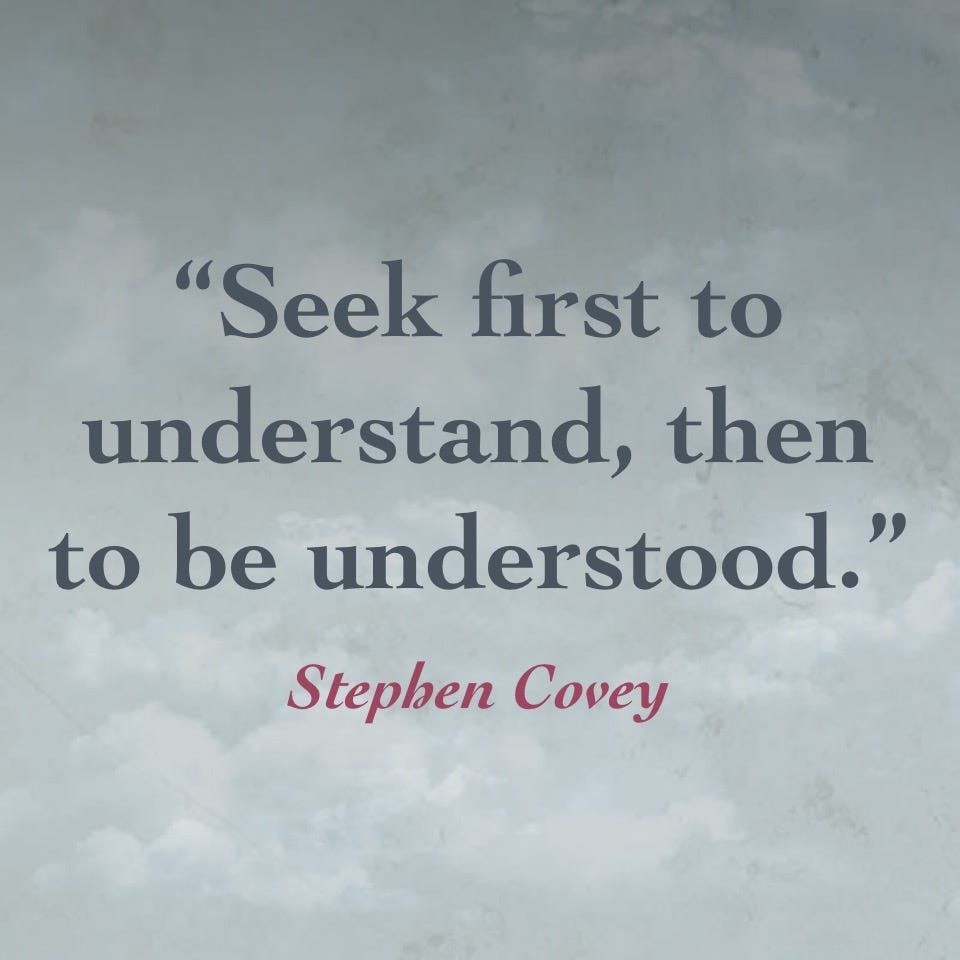
That’s why this Stephen Covey quote matters: “Seek first to understand, then to be understood.”
That kind of communication focuses on the other person first. It takes responsibility for oneself and for the communication process. It reminds us that the burden is on us to ensure the message we’re trying to get across lands the way it should.
That burden has always been on the communicator, not the receiver, yet it seems to be quickly forgotten.
Covey obviously wasn’t the first to say something like this.
Solomon in Proverbs 18:2 says, “A fool takes no pleasure in understanding, but only in expressing his opinion.”
That stings.
Most of us express opinions before understanding others or the situation.
Plutarch said, “We observe that a poor use is made of this by the great majority of persons, who practice speaking before they have acquired the habit of listening.”
And St. Francis of Assisi is credited with praying, “Grant that I may not so much seek…to be understood as to understand.”
So, how do we apply this ancient wisdom in today’s society?
First, slow your reaction.
This may seem obvious, but it’s worth saying again for the people in the back. The slower the reaction, the better the response. Let wisdom, not emotion, lead.
Second, study their perspective.
Before you decide what you want to say, ask what they may see, feel, fear, or value that you may be missing. That is what allows for empathetic communication. It means trying to put yourself in their shoes first.
Third, shape your response.
After understanding, choose words that help—not just those that win arguments or inflame the other further.
It’s not easy to do this in an age of outrage and instantaneous communication.
Slowing reactions, studying perspectives, and shaping responses help us seek to understand first.
And when we do, we just might be better understood.